European Astrocartography Interview Series 2025‐26
Martin Davis was among the first astrologers to systematically interpret the interaction between Astro*Carto*Graphy and Local Space within emerging Astromapping software environments. He demonstrated how their intersection produces intensified zones. He originally defined these zones as "bi-parans", later establishing the term "Destiny Points" in his work.
Martin Davis, photographed during his later European period, when his work on integrating Astro*Carto*Graphy and Local Space had reached its most developed form.
Martin Davis at Niarbyl, Isle of Man, c.2009. Photograph by Robert Currey.
Davis worked at the intersection of two independently developed locational systems —Jim Lewis's Astro*Carto*Graphy and Michael Erlewine’s Local Space. He occupies a singular position in the history of modern astrological practice. His contribution was neither derivative nor oppositional. It was integrative at a time when these systems were largely treated in isolation. Through software, case studies, and teaching, Davis demonstrated how their combined use revealed a deeper layer of spatial interpretation.
This article reconstructs Martin Davis's contribution through his own words, published work, and recorded lectures. Structured as a posthumous interview, it follows the same methodological framework used throughout the European Astrocartography Interview Series. This allows his own voice, terminology, and technical reasoning to define the narrative.
This study concentrates on the theoretical development of Destiny Points and Martin Davis's interpretation of the crossing points produced through Astro*Carto*Graphy and Local Space mapping.
A future article will examine their practical application through case studies and lived experience.
Astromapping and the Matrix Era
"The Astromapping techniques of Astro*Carto*Graphy, Local Space and Geodetics have become widely available to all through their inclusion in contemporary astrological software. This is surely one of the most revolutionary developments of modern astrology."
Early on, Davis had direct access to computational tools that made his observations possible and repeatable. This technical access, at a time when most astrologers still worked primarily through manual calculation and printed charts, gave him a leg up. Combined with a practitioner's curiosity, precise locational astrology software allowed him to move beyond description into demonstration. Then, from demonstration to theory.
Much of this work became possible through the emergence of Matrix software environments capable of overlaying multiple locational systems simultaneously. Davis distinguished himself through how he interpreted and theorised these visual relationships rather than through software engineering itself.
The result was a body of work spanning two decades, including articles, lectures, and two major publications. He established a method to read and interpret the interaction between planetary lines and local space directions. He later referred to his approach as "Astromapping" and set up a website called AstrologyMapping.com.
Davis's terminology also evolved alongside his practice. What began as the technically precise concept of "bi-parans" in earlier writings was later communicated more accessibly as "Destiny Points." This is the term that gained wider recognition within the field, still in use today.
This shift reflects a broader characteristic of Davis's approach. He was known to make a consistent effort to translate complex spatial relationships into usable interpretive tools. That capacity made him widely appreciated and well‐liked on the conference and workshop trail.
Without direct access to state‐of‐the‐art tools capable of overlaying multiple astrological systems onto geographic space, Davis could not easily have moved beyond conceptual comparison. This is where the visual nature of Astromapping becomes essential.
Martin Davis on the "Consultations" page of his website AstrologyMapping.com (archive 2007), illustrating his professional practice during his active consulting period.
Visualising "Destiny Points"
"Without the maps, you wouldn't see it."
"In 1989, I was one of the first to receive Matrix Software's DOS program Astro Maps Hi Res which allowed me to begin my own in‐depth research and then to pass my insights on to others in articles, workshops and lectures."
Example of Matrix Software's early relocation mapping system, used and promoted by Martin Davis during the late 1980s and 1990s. The map overlays Madonna’s astrological relocation lines across the United Kingdom and Europe.
Even by current standards, Matrix Horizons remains remarkably sophisticated in the range of locational techniques it could integrate. Matrix itself describes Horizons as a "Professional Astromapping Program" and says Matrix WinMaps "set the standard for relocation software."
It also explicitly links Jim Lewis to Matrix for Astro*Carto*Graphy software and Michael Erlewine to Local Space, placing both technical lineages inside the same software ecosystem.
Conceptual illustration accompanying the theoretical integration of AstroCartoGraphy and Local Space astrology explored by Martin Davis during the late 1980s and 1990s. The reflective structure symbolises the emergence of intensified crossing points later described as "bi-parans" or "Destiny Points" within Astromapping practice.
"When you put the two systems together, something new appears… the crossing points become highly significant."
Davis's work begins precisely at this moment of observation.
By the late 1980's, Astro*Carto*Graphy and Local Space were well‐established as independent techniques. One technique was global and projection‐based, the other localised and directional. What Davis recognised, and then pointed out in the 1990's, was that these systems were not parallel. They were intersecting.
Davis observed that when an Astro*Carto*Graphy angular line coincided geographically with a Local Space directional emphasis, the resulting locations often produced intensified experiences. These crossings appeared more concentrated, event-oriented, and psychologically immediate than broader line interpretations alone.
"ACG lines show empowerment of planetary archetypes at a given location. LS has a different quality to it’s directions. It’s the Feng Shui in a situation, requiring us to trust our intuition."
Michael Erlewine, the creator of Local Space, expresses similar thoughts. He says:
"We are drawn towards our Local Space directions to fulfil the needs which require those specific energies."
Davis's case studies consistently return to this principle: events, encounters, and turning points tend to cluster around these crossings. The precision of these locations, often down to specific cities or neighborhoods, distinguishes them from broader ACG line interpretations.
Genesis of the "bi‐paran"
In its more technically precise formulation, this involved the intersection of an Astro*Carto*Graphy angular line with a paran relationship — what Davis later described as a "bi‐paran."
The term "bi‐paran." was and is technically more precise. In locational astrology, a paran describes the simultaneous angularity of two planets at a given latitude. Davis extended this principle spatially by observing locations where an angular planetary line and a local directional line converged geographically on the same place.
This distinction is important. A paran itself is not limited to a single point. It extends across the full latitude at which the angular relationship occurs. Davis therefore distinguished between the wider paran field and the intensified crossing location where multiple spatial conditions converged simultaneously.
A Framework at the Edge of Development
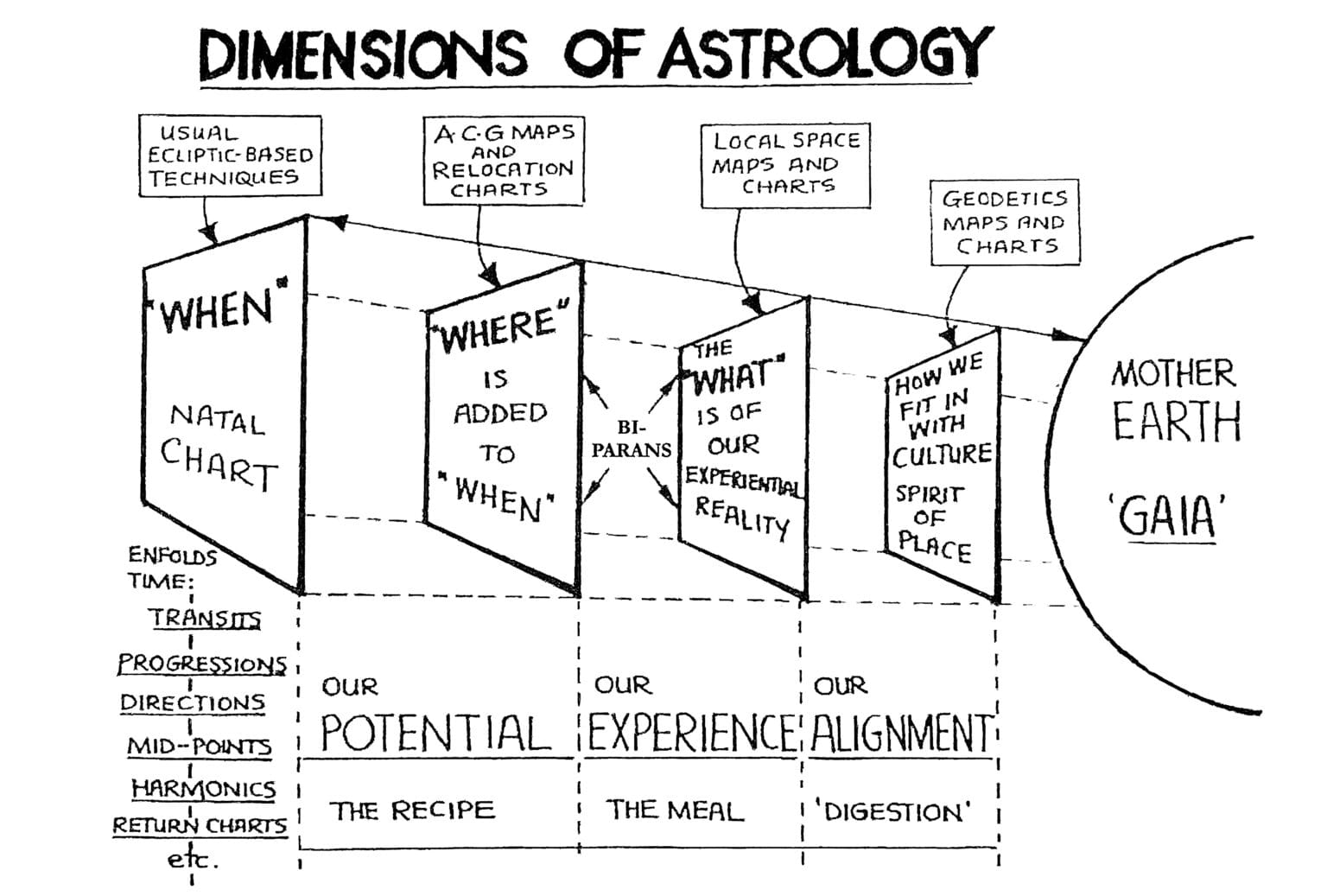
The appendix to Astrolocality Astrology (1999), titled The Dimensions of Astrology, offers a rare and revealing insight into Martin Davis's late‐stage thinking. Presented as a hand‐drawn diagram rather than a formal chapter, it stands apart from the main body of his work in both form and intention.
This diagram, titled The Dimensions of Astrology, illustrates Davis's later conceptual framework and his placement of Destiny Points between astrocartography and Local Space.
Published with the permission of The Wessex Astrologer.
"The Dimensions of Astrology," diagram by Paul F. Newman, published in Appendix Five of Astrolocality Astrology by Martin Davis (The Wessex Astrologer). The model positions Destiny Points (bi‐parans) between Astro*Carto*Graphy and Local Space as the transition from geographic potential to lived experience.
In this model, Davis places Astro*Carto*Graphy, Local Space, and Geodetics within a shared conceptual framework, positioning each technique along a continuum moving from temporal description toward lived experience. Notably, he places "Destiny Points" between the domain of Where (defined by astrocartography and relocation) and the domain of What (as experienced through Local Space).
This placement is not incidental. It reveals how Davis ultimately understood the function of these crossings as experientially real. Davis appears to position "Destiny Points" as the transition between geographic indication and lived encounter. They identify where a place ceases to be theoretical and begins to register in concrete experience.
The fact that this framework appears in an appendix, in diagrammatic form, suggests a line of thought still actively being refined. Rather than a finished doctrine, it reads as a working model. He seems to be working through, almost as an afterthought, the relationships between systems that had previously been treated in isolation. In this sense, the diagram does more than summarise his work; it actually extends it.
The diagram was illustrated by Paul F. Newman as part of Appendix Five in Astrolocality Astrology (1999), The Wessex Astrologer, reflecting Davis’s late conceptual synthesis.
Making Astromapping Understandable
Seen from this perspective, Davis's later acceptance of the term "Destiny Point" gains clarity. It reflects a shift toward communicating the experiential significance of these locations, while still grounded in the technical structure of "bi-parans". The terminology evolves, yet the underlying logic remains precise: these are the points at which multiple spatial systems converge with sufficient strength to produce lived, observable effects.
However, the broader integrative framework does not reappear in formalised form in his later publications. As Davis adopts a more empirical approach‐consolidating techniques, demonstrating applications, and working through case studies‐the emphasis shifts from system-building to transmission.
The diagram can therefore be understood as an unfinished and transitional artefact in the history of Astromapping. It reflects an attempt to articulate relationships between spatial systems that Davis was already demonstrating in practice, particularly through emerging computational tools.
Trained as an engineer ‐ he graduated New York University in 1959 with an engineering degree ‐ Davis approached astrology with a clear systems-based mindset. Yet what distinguished him was not only his ability to conceptualise complexity, but his capacity to communicate it clearly. Rather than extending this framework into a more elaborate theoretical structure, he chose to simplify its expression.
In his last book, From Here to There, he made Astromapping observable, teachable. It is widely used by professional astrocartographers and students alike. This ability to translate complex spatial relationships into accessible language is central to understanding both his work and its lasting influence.
From "bi-Paran" to "Destiny Point"
Davis's Own Explanation (2008)
"They are really bi‐parans but I called them Destiny Points because people understand that."
This excerpt from Martin Davis"s 2008 Astrological Association lecture clarifies his terminology. Referring back to his work in 1988‐1989, he explains that the crossings between Astro*Carto*Graphy and Local Space were originally defined as "bi‐parans", while "Destiny Points" was introduced later as a communicative term.
Martin Davis, astrologer and developer of Astromapping, whose work integrated Astro*Carto*Graphy, Local Space and Geodetic systems.
Astro*Carto*Graphy Mapping in Mundane Studies, Astrological Association Conference (2008), Martin Davis.
Martin Davis, Astro*Carto*Graphy Mapping in Mundane Studies, Astrological Association Conference, 2008 (AA recording R0542). 49-second excerpt used with permission. [Source: Astrological Association]
FULL TRANSCRIPT
"I always put up the one of me making the Olympic team to show off. And then I gave a name for that crossing, which I'm a little embarrassed about. I called it a destiny point, because I wanted to get people"s attention.
It was 1988 and ’89. But I'm hoping people, if they refer to it in their work, I hope you'll use the word bi-paran. 'Bi' from two systems, 'paran' meaning a crossing.
So please use bi‐paran. 'Destiny points' left me with a little bit of an embarrassment."
Martin Davis, 2008
Primary Source: The 1989 Definition
First Published Formulation (1989)
Davis's later explanation (2008) aligns directly with his first published formulation in 1989, establishing continuity between his original technical framework and its later communicative expression.
"Bi-paran" remains the technically precise term, grounded in astronomical language, while "Destiny Point" functions as a communicative adaptation. The terminology evolves, while the underlying structure remains unchanged.
"I named the intersections Destiny Points, or more technically, bi‐Parans (crossings from two systems). In 1989, I published this finding as part of an article entitled : Local Space Astrology, where I first proposed the mixing of LS and A*C*G information on one map."
The following primary source from 1989 documents Davis's original definition of "bi-parans" within the integration of Astro*Carto*Graphy and Local Space.
The Astrological Journal, November‐December 1989 (Vol. XXXI, No. 6), featuring Martin Davis's article Local Space Astrology, where the term 'bi-parans' is formally defined.
Taken together, these sources establish a clear development.
In 1989, Davis formally defined the crossings of Astro*Carto*Graphy and Local Space as 'bi-parans.' In later lectures and publications, he introduced 'Destiny Points' as a communicative bridge, while maintaining the same underlying structure.
The conceptual structure remains consistent; the terminology adapts to context.
From his later publications, beginning with Astrolocality Astrology (1999) through to From Here to There: An Astrologer's Guide to Astromapping (2008), Davis consistently adopts "Destiny Points" as a communicative term, while retaining the original technical framework.
This dual vocabulary reflects a consistent pattern in his work:
technical precision at the foundation
practical language at the point of teaching
The Legacy of Martin Davis
Martin Davis (1937‐2022) occupies a distinct place in the development of modern locational astrology. Trained originally as an engineer, certified in Jim Lewis's Astro*Carto*Graphy by Continuum, he approached astrology through systems, structure, and spatial relationships, bringing an unusually technical mindset to the emerging field of Astromapping.
Working initially through Astro*Carto*Graphy, Local Space, and later Geodetics, Davis became one of the first astrologers to extensively explore how these locational systems interacted when examined together rather than separately. Through software, lectures, publications, and teaching, he demonstrated how overlapping spatial techniques could reveal concentrated geographical zones of intensified experience.
In 1999, Davis published Astrolocality Astrology, followed in 2008 by From Here to There: An Astrologer's Guide to Astromapping, both through The Wessex Astrologer. Across these works, he increasingly adopted the broader term Astromapping to describe a more integrated approach to locational astrology extending beyond Astro*Carto*Graphy alone.
His work on crossing points between Astro*Carto*Graphy and Local Space became one of his most enduring contributions. Initially defined technically as 'bi-parans', he later popularised the more accessible term 'Destiny Points' while maintaining the same underlying conceptual framework. Davis consistently emphasised that these locations emerged through the interaction of multiple spatial systems rather than through isolated techniques viewed independently.
The appendix diagram The Dimensions of Astrology, published in Astrolocality Astrology (1999), offers a rare insight into his later conceptual thinking. Positioned between Astro*Carto*Graphy and Local Space, Destiny Points appear within the model as the transition between geographical potential and lived experience ‐ a spatial threshold where place becomes experientially real.
Davis belonged to the first generation of astrologers‐astrocartographers, certified in Jim Lewis's Astro*Carto*Graphy at Continuum, and able to work directly with emerging computational mapping software. This avant‐garde technological environment (Matrix) allowed him to visualise and communicate complex locational relationships with a level of precision previously difficult to demonstrate consistently through manual methods alone. His contribution ultimately lay not only in technical observation, but in his ability to make complex spatial astrology understandable and teachable for future generations of practitioners.
Martin Davis's Books
Davis's major works remain foundational texts for astrocartography students.
Martin Davis, Astrolocality Astrology: A Guide to What It Is and How to Use It.
The Wessex Astrologer, Bournemouth, 1999.
Martin Davis, From Here to There: An Astrologer's Guide to Astromapping.
The Wessex Astrologer, Bournemouth, 2008.
Both titles remain available through authorised international and European book distributors.
Editorial Closing
This first part has concentrated on the theoretical and historical development of bi‐parans and Destiny Points through Martin Davis"s publications, diagrams, software work, and recorded explanations.
Part II will examine how these crossing locations operated in practice through case studies, geographical concentration of events, and the lived experience associated with intensified locational environments.
Timeline of Martin Davis's Astromapping Development
1988‐1989
Martin Davis develops the concept of "bi‐parans" through the integration of Astro*Carto*Graphy and Local Space techniques. The term is formally introduced in his 1989 article Local Space Astrology published in The Astrological Journal.
1990s
Davis continues refining the interaction between multiple locational systems through lectures, software experimentation, and applied case studies.
1999
Publication of Astrolocality Astrology: A Guide to What It Is and How to Use It through The Wessex Astrologer. Appendix Five, The Dimensions of Astrology, presents Davis's late conceptual framework positioning Destiny Points between Astro*Carto*Graphy and Local Space.
Early 2000s
Davis increasingly adopts the broader term Astromapping to describe an integrated approach to locational astrology combining Astro*Carto*Graphy, Local Space, and Geodetics. During this period, he develops and promotes his personal consulting practice at AstrologyMapping.com.
2008
Publication of From Here to There: An Astrologer's Guide to Astromapping. Davis consolidates decades of research into a more accessible and teachable framework for Astrocartography students and practitioners.
2008
At the Astrological Association Conference, Davis publicly clarifies that "Destiny Points" were originally termed "bi-parans," acknowledging the later terminology as a communicative adaptation intended to make the concept more understandable to the public.
2022
Death of Martin Davis (1937‐2022), whose work remains influential in the development of modern locational and spatial astrology.
Author and Editor: Kristine Odegard, Certified Astrocartographer.
This article forms part of the European Astrocartography Interview Series, an editorial publication series edited and published by Kristine Odegard.
CREDITS: The background tile came from ABC Giant.
The maps are from a free geographic clipart collection at Graphmaps.
The animated globe is by Iband.
Web design by Donna Cunningham
Martin Davis at Niarbyl, Isle of Man, c.2009. Photograph by Robert Currey.

Example of Matrix Software's early relocation mapping system, used and promoted by Martin Davis during the late 1980s and 1990s. The map overlays Madonna’s astrological relocation lines across the United Kingdom and Europe.
Conceptual illustration accompanying the theoretical integration of AstroCartoGraphy and Local Space astrology explored by Martin Davis during the late 1980s and 1990s. The reflective structure symbolises the emergence of intensified crossing points later described as "bi-parans" or "Destiny Points" within Astromapping practice.
Martin Davis, astrologer and developer of Astromapping, whose work integrated Astro*Carto*Graphy, Local Space and Geodetic systems.
The Astrological Journal, November‐December 1989 (Vol. XXXI, No. 6), featuring Martin Davis's article Local Space Astrology, where the term 'bi-parans' is formally defined.



